Your e-bike's motor, battery and display are not designed to survive a 90-minute motorway drive in driving rain, yet that's exactly what happens every time you strap it to a hitch rack and head off on holiday. A cheap plastic bag rips apart within a few kilometres, and even many "universal" bike covers leave the underside exposed to the exact spot where road spray hits hardest.
If you've ever arrived at a campsite to find your e-bike's display fogged up and the motor casing dripping, you already know the plastic-bag trick doesn't work. Here's what actually stops water getting into the electronics, based on how road spray behaves and what fitted transport covers are built to do.
Key takeaways
- Road spray travels upward and sideways, not just downward, so any cover that only shields the top of the bike leaves the motor and battery, both mounted low, exposed to the worst of it.
- Loose-fit "universal" covers flap at 100+ km/h, and that flapping repeatedly opens a gap at the bottom seam, which is precisely where owners report water getting in underneath even with a cover fitted.
- A fitted cover cut specifically for hitch-rack transport uses an elasticated or drawcord hem that stays cinched against the frame at speed, closing the gap that loose covers can't.
- Plastic bags fail within roughly one motorway journey because they are not rated for sustained wind load or abrasion, they tear at the point where they're tied off, which is usually right at the motor.
- Water ingress at electronic connectors is the real risk, not surface dampness, because connector corrosion and display fogging are what cause expensive faults, not a wet paint job.
1. The Plastic Bag Method
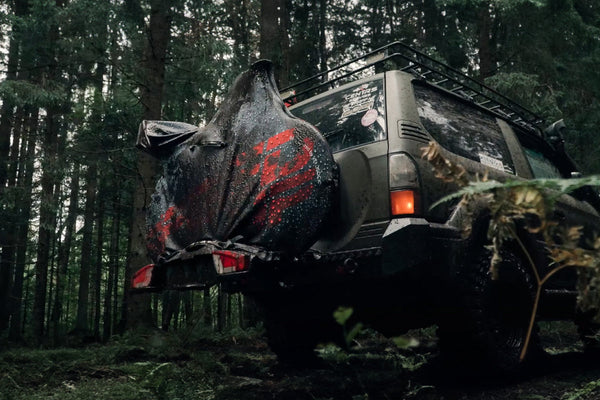
Wrapping the motor or the whole downtube in a bin liner or shopping bag is the first thing most riders try, usually because it's what's in the boot. It costs nothing and takes thirty seconds to apply, which is exactly why it's so common.
Effectiveness
A plastic bag can keep light drizzle off a stationary bike, but it does almost nothing once the bike is moving at speed. Wind load inflates the bag like a sail, and the constant flexing works the plastic against the ties until it splits, usually within the first hour of a motorway drive.
Durability
Standard polyethylene bags are not engineered for sustained abrasion or UV exposure. Repeated flexing at speed causes UV and mechanical stress to weaken the polymer chains within a single trip, which is why riders on long tours often report shredded plastic wrapped around the axle by the time they stop.
Practicality
Fitting a bag takes seconds, but re-fitting it at every fuel stop, because it has shifted or torn, is not practical on a multi-day trip. There is also no way to bag the underside of the motor without leaving the tie point exposed to direct spray.
Price
Effectively free, but the hidden cost is a wet or corroded motor connector and a service bill that can run into hundreds, which is a poor trade for saving the price of a proper cover.
2. Universal Loose-Fit Tarp Covers
These are the generic covers sold as "one size fits most", usually a rectangular sheet with a basic elastic hem, designed primarily for static storage rather than transport.
Effectiveness
They cover more surface area than a bag, but loose material billows at speed, and that billowing creates the exact gap-and-flap cycle that pulls road spray in from underneath. This matches what owners describe when they say water gets thrown up from the road and finds its way under the cover regardless.
Durability
Because they are not cut to the bike's profile, the fabric rubs against the frame, cabling and the motor unit itself during transport. Over repeated trips this abrasion wears thin patches, and the flapping motion places far higher aerodynamic drag and cyclic stress on the material than a fitted shape ever would.
Practicality
Loose covers are quick to throw over the bike, but the loose hem still needs manual tucking and re-tucking, and most designs weren't drawn up with a hitch-mounted motor or a protruding battery pack in mind.
Price
Mid-range, often less than a dedicated fitted transport cover, but the ongoing risk of underside water ingress makes them a false economy for anyone carrying an e-bike rather than an unpowered bike.
3. Fitted Aerodynamic Transport Covers
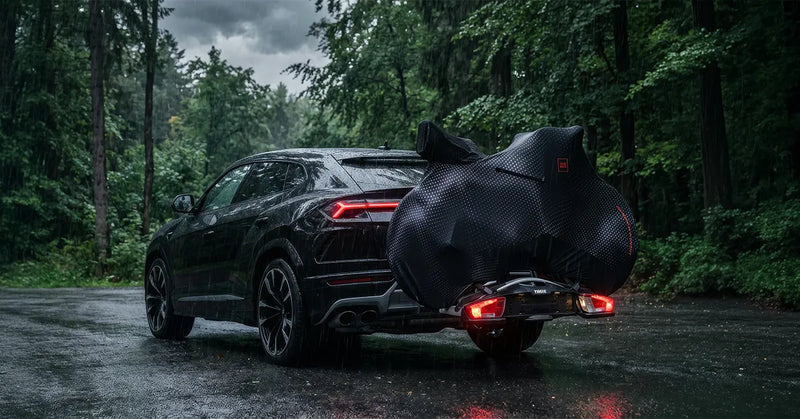
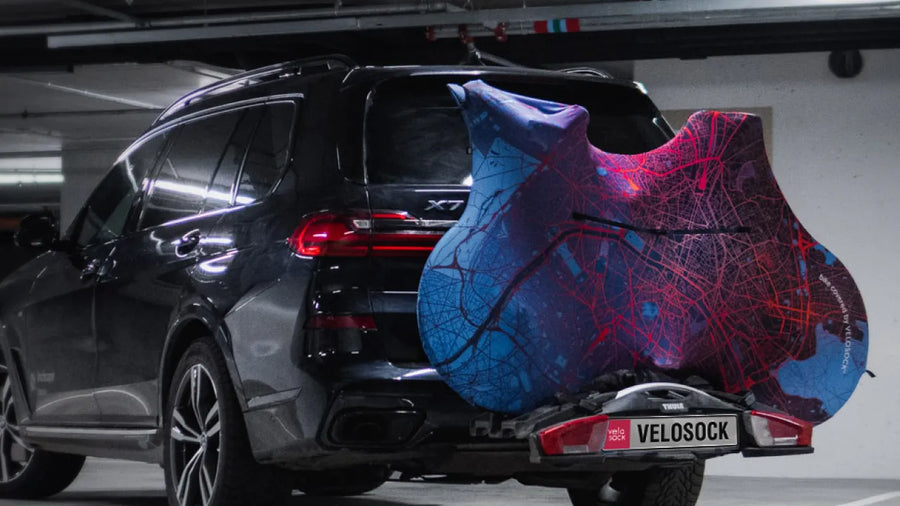
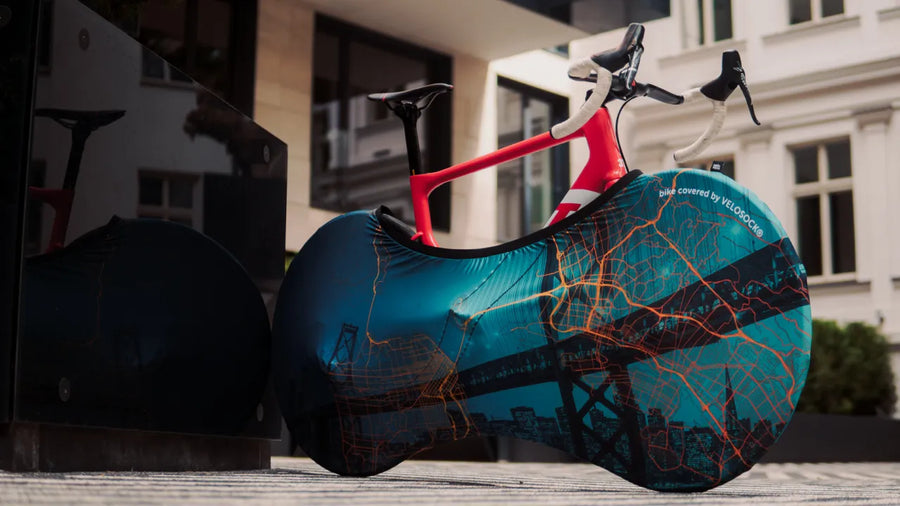
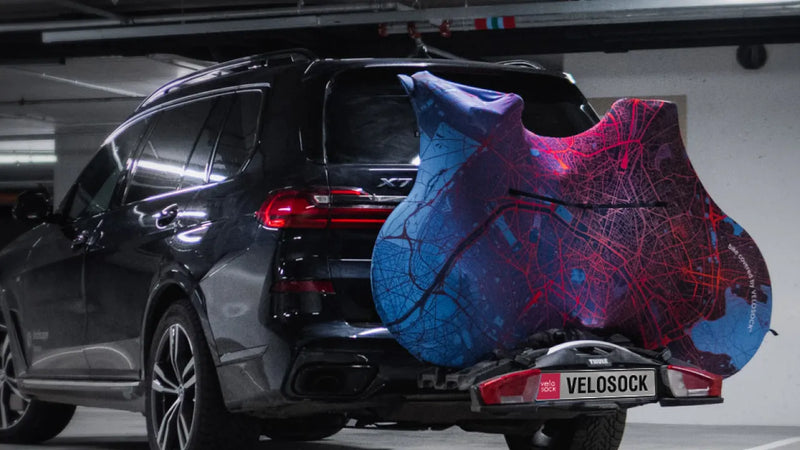
This is the category built specifically for the problem: a cover cut to the bike's shape, designed to be driven at motorway speed on a roof, hitch or towbar rack without flapping loose.
Effectiveness
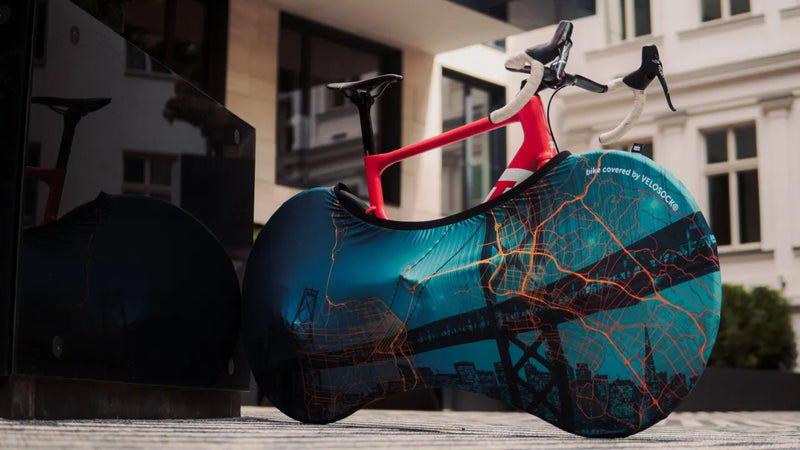
Because the cut is fitted rather than draped, there is no loose fabric for wind to catch, which means the hem stays cinched close to the frame and motor housing even in crosswinds. This is the mechanism that actually closes the gap that plastic bags and loose tarps leave open at the bottom of the bike, exactly where the motor sits. Velosock's covers built for car and hitch rack transport are shaped around the frame for this reason.
Durability
A fitted cover doesn't rub against the motor casing or display because it holds its shape rather than shifting with the wind, so there's far less cyclic abrasion over repeated journeys. Riders touring for multiple days benefit most, since the cover isn't being re-tucked or replaced mid-trip.
Practicality
Fitted covers go on in under a minute and stay in place for the whole journey, no retying at fuel stops, no checking the hem has slipped. For anyone hauling an e-bike or recumbent trike behind a motorhome, that's the difference between arriving with a dry motor and arriving with a soaked connector block.
Price
Higher upfront than a bag or a generic tarp, but priced per trip protected it compares favourably once you factor in avoided corrosion, avoided display fogging and the fact that a single cover typically lasts for seasons of regular use rather than a single journey.
Protect the motor, not just the paintwork
If you're hauling an e-bike on a hitch or towbar rack, a fitted cover that stays sealed at speed is the simplest fix for the gap generic covers leave underneath.
Shop fitted covers for hitch and towbar rack transport| Protection method | Stops water at motor/battery | Survives motorway speed | Setup time | Typical lifespan |
|---|---|---|---|---|
| Plastic bag | Poor, tears at speed | No, wind-inflated | 30 seconds | 1 trip |
| Universal tarp cover | Partial, gaps under flapping | Limited | 2-3 minutes | Several trips |
| Fitted transport cover | Good, hem stays cinched | Yes, designed for it | Under 1 minute | Multiple seasons |
The pattern across all three options is consistent with what riders report in real touring situations: it isn't rain falling from above that soaks an e-bike's electronics, it's road spray thrown upward from the tyres of vehicles ahead, and that spray finds any gap left by a loose or ill-fitting cover.
Choosing the Right Fit for Your Rack Position
Effectiveness
A cover's fit matters more on a hitch rack than a roof rack, because hitch-mounted bikes sit closer to tyre spray from following traffic and from the towing vehicle's own wheels. The motor and battery, usually mounted low on the frame, take the brunt of it.
Durability
Covers designed for towbar and hitch use need reinforced stitching at stress points, since the constant vibration from a lower, more exposed mounting position places more cyclic load on the seams than roof transport does.
Practicality
Look for a cover with a dedicated cut-out or reinforced access point for charging cables if you plan to charge en route, rather than removing the whole cover at every stop. Velosock's range of full bike covers for transport are shaped with motor and battery placement in mind rather than a generic rectangle stretched over the frame.
Price
Spending slightly more for a cover matched to hitch-specific exposure is usually cheaper over a season than repeatedly replacing torn generic covers or drying out a display after every trip.
Conclusion
Plastic bags and generic tarp covers both fail at the same point: they can't stay sealed against the frame once wind gets under them, and that's exactly where an e-bike's motor and battery sit. A fitted, aerodynamic cover built for hitch and roof rack transport solves this by staying cinched at speed rather than flapping loose, which is why it closes the gap that causes the water-ingress complaints riders raise again and again in touring forums. If you're regularly hauling an e-bike, recumbent trike or cargo bike on a rack, a properly fitted cover is the more reliable and, over a season of trips, the more cost-effective choice.
FAQs
Will a fitted cover really stop water getting to my e-bike's motor?
A fitted cover won't make the bike fully waterproof in a downpour, but by staying cinched against the frame at motorway speed it closes the gap that loose covers leave open at the bottom, which is the main route water takes to reach the motor and connectors during transport.
Can I still charge my e-bike battery while the cover is on?
Most fitted transport covers are designed to be removed quickly at stops rather than charged through, since the goal is sealing the bike during motion. If you need to charge mid-journey, plan for a brief stop to remove and refit the cover rather than leaving cables exposed under it.
Is a fitted cover better than wrapping just the motor in a plastic bag?
Yes, because a plastic bag only addresses one component and typically tears within a single motorway journey due to wind load. A fitted cover protects the whole bike, including cabling, the display and the battery housing, and holds its shape rather than flapping and splitting.
Do I need a different cover for a hitch rack compared to a roof rack?
Not necessarily a different product, but hitch-mounted bikes sit lower and closer to road spray from following traffic, so a well-fitted hem and reinforced stitching matter more in that position. Choosing a cover built for car-rack and hitch transport rather than static storage is the key distinction.